By Hanna Kaye Verhagen, RCC, CCC, MC, DVATI, BA
If you’re in Victoria, BC or anywhere else in Western Canada and curious about ACT, this post covers the basics.
What does ACT Stand for?
ACT stands for Acceptance and Commitment Therapy. ACT is pronounced as the word, act, which is unlike many other approaches that go by their initials (e.g. CBT, DBT, etc.). The name’s choice is fitting since ACT is all about taking actions that move you towards a meaningful life, while accepting what’s out of your control.
What is ACT?
ACT is an evidence-based behavioural and cognitive psychotherapy approach developed by psychologist Steven Hayes in the 1980s. The approach combines mindfulness and acceptance strategies with commitment to behaviour change. Instead of treating anxiety, grief, or stress as problems to eliminate, ACT works on your relationship to those experiences, so they have less power to keep you stuck.
The goal of ACT is to build psychological flexibility: the ability to stay present with hard emotions and still choose actions aligned with your values.
How is ACT Different From Traditional CBT?
Traditional cognitive behavioural therapy (CBT) often works by challenging or restructuring unhelpful thoughts. ACT takes a different approach. For example, where CBT would try to change a thought, ACT focuses on changing how much pull that thought has over you. When dealing with unhelpful thoughts, ACT’s aim is to help you learn to notice them, let them be there, and choose your next move without them steering your decision.
In practice, this means spending less time engaging with these thoughts and debating whether a thought is “true” or “false.” Instead, more time is spent asking what actions you can take towards your values, despite an unhelpful thought’s presence.
What are the Core Components of ACT?
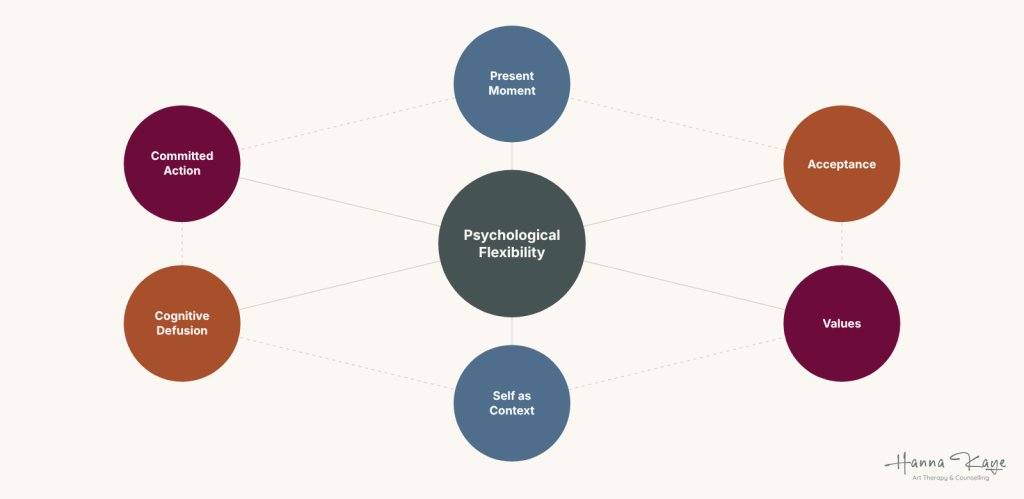
ACT consists of six core processes:
- Committed action
Taking steps towards your values, even when it’s uncomfortable. - Acceptance
Making room for thoughts and feelings rather than pushing them away. - Cognitive defusion
Learning to notice a thought as just a thought, not a fact you must obey. - Being present
Staying grounded in what’s happening now, rather than stuck in the past or pulled into the future. - Self as context
Relating to yourself as the one noticing your thoughts and feelings, rather than being defined by them. - Values
Clarifying what matters most to you and using this as a compass for decision-making.
Can ACT be Combined With Art Therapy?
Yes, ACT blends well with art therapy. In my practice, I use ACT as a framework and bring in the creative art therapy process to help clients explore and express their thoughts, feelings, and what tends to sit below the surface and can be harder to reach through words alone.
This pairing is especially useful for trauma-related patterns, since difficult experiences aren’t always stored as thoughts you can easily name or talk through.
When a feeling is too tangled for words, art gives it somewhere to go first. That’s ACT’s acceptance and defusion processes at work. The page holds what’s too big to say out loud, and once it’s there, we can look at it together instead of you carrying it alone.
What Does an ACT Session Look Like?
Sessions often start with what’s going on for you right now, then move into noticing the thoughts and feelings that come up. From there, we look at what you’d be doing, and how you’d be showing up, if those thoughts and feelings weren’t running the show. That’s where values and committed action come in, deciding what small, real step fits with the life you want to live.
Is ACT Evidence-Based?
Yes. A 2015 meta-analysis published in Psychotherapy and Psychosomatics found ACT effective for a range of mental and physical health concerns, and it’s recognized internationally as a research-backed approach for anxiety, depression, chronic pain, OCD, and stress.
Curious whether ACT is the right fit for you? Book a free 15-minute consultation and we’ll figure it out together.
Quick Answers
What does ACT stand for?
Acceptance and Commitment Therapy. It’s pronounced as one word, “act,” not spelled out.
Is ACT the same as CBT?
No. While ACT and CBT are both considered cognitive behavioural therapy approaches, they work differently. CBT often focuses on changing unhelpful thoughts directly, while ACT focuses on changing your relationship to those thoughts so they have less control over your actions.
What conditions does ACT help with?
ACT is commonly used for anxiety, depression, chronic pain, OCD, grief, and general stress, and it pairs well with other approaches, including art therapy.
Do I need to talk about my past for ACT to work?
Not necessarily. ACT itself tends to focus more on your present relationship to thoughts and feelings and where you want to go next, rather than digging extensively into history. That said, in my practice I draw connections to past patterns of behaviour, trauma responses, and the ways your brain and body have adapted to past experiences when it helps make sense of what’s showing up for you now.
Where can I try ACT therapy in Victoria, BC?
I offer individual counselling using ACT, both in-person in downtown Victoria and online across BC and Western Canada, with art therapy and art-making available as part of the process if it’s a good fit for you. You can book a free consult here.